
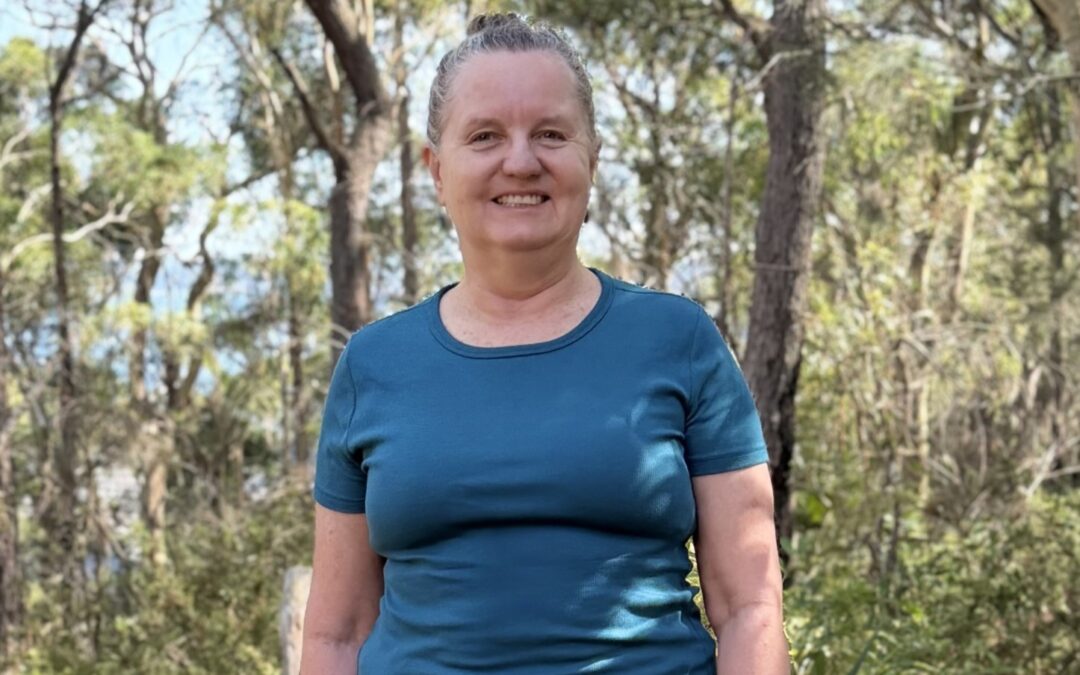
I think I was predestined to join the Greens.
My father was born in the west of Poland, then under German control, in 1915. He grew up in a small village, and told stories about going hungry, not having shoes and his family having to dig themselves out of the house from under six feet of snow.
However, encouraged by the village school and with the support of a scholarship, he managed to complete high school and study to become an aeronautical engineer before training as an army officer.
Details of his life then become a little unclear – as is often the case for the children of those who live through war. He spent six years as a forced labourer in German prisoner of war camps. His stories of those years often concluded with him shaking his head and saying: “That fellow perished”.
In 1949 he sailed to Australia as a Displaced Person – landing in Woomera where, with other refugees, he spent two years labouring at the rocket range and living in a tent in the desert.
At Woomera, he quickly learnt English and was later fortunate to land a job as a design draftsman at Qantas in the early ‘50s. He lived the rest of his life in Sydney where I grew up and only ever managed to return to Poland once to see his sister. The first attempt in August 1968 was aborted when we as a family arrived in Vienna, about to drive into Czechoslovakia the next day, only to see tanks on the roads and the border blocked.
So like many daughters of fathers raised in poverty who “make good” in the world, I was drawn to left-wing politics.
However, I also give credit to my mother, a child of the Depression, separated from her father in Sydney when he couldn’t find work, and with her mother, going to stay with relatives in Melbourne. The family did not live under the same roof again until after WW2 when my grandfather had saved enough to rent and run a milk bar in Kogarah. Eventually, when he was incapacitated with TB, my grandmother kept the family afloat running a boarding house in Paddington. As a child I was amazed by my mother’s intense empathy for others, especially for patients she treated as a radiotherapist.
Growing up at Ramsgate, my schools had very mixed demographics. At my public girls high school, Moorefield at Kogarah, the teachers ditched the school song and we sang “I Am Woman” in assembly each week. One of my favourite teachers, Mrs Price, taught us history, always telling us we should be aware of her bias. That bias only confirmed the direction my parents had set.
Studying history and Aboriginal Studies at the ANU helped me pull the story together. My favourite lecturer was Daphne Gollan, a Russian expert who taught Modern Revolutions with Bruce Kent, a China specialist. Daphne exhorted us to “Think of the poor workers”, and while she had the utmost sympathy for peasants, clearly thought that while “Peace, Land and Bread” had driven the October 1917 Russian revolution, without the Bolsheviks, it might well have floundered.
I always wondered what Daphne’s politics were. A staunch feminist, in a previous life she had worked for a union and later resigned from the Communist Party after Stalin’s atrocities came to western notice. Her criticism of liberal democracies was trenchant. Where did she fit in?
At the same time I joined Labor, spending my university break in 1982 campaigning for Ros Kelly in the seat of Canberra, and election night scrutineering before ending up at the Tally Room. However, the euphoria of Hawke’s victory over Fraser and the Razor Gang was short-lived. Despite the re-introduction of public health insurance, the Labor government proceeded to undermine and later destroy the union movement, introduce university fees, and privatise national assets. It was also telling, attending Labor branch meetings, with the comrades introducing one motion after another calling for actions by MPs that were totally ignored.
My involvement lapsed when I spent several years living overseas, then returning to Australia as a journalist, remained on the sidelines to keep up the appearance of independent reporting. However, when Whitlam died I decided to rejoin, despite the party’s appalling treatment of refugees, thinking if the “true believers” weren’t in there, what hope did the party have?
Fortunately, central office stuffed up my membership application, despite me chasing it up a couple of times. At that point, Pru Wawn, a stalwart of Northern Beaches Greens and with me, the local P&C, recruited me for election day duty. I soon decided to read the whole of the Greens’ policy platform and was delighted by its breadth. It contained everything I had ever dreamt of! Finally in 2015, I joined up to fight the 2016 federal election in Mackellar.
For me this was a homecoming – I had found my tribe. This was only confirmed a few years later when I read Paddy Manning’s book, Inside the Greens. There I discovered that Daphne Gollan was a founding member of NSW Greens in 1984, and was also the first Green to contest the federal election in NSW. The mystery was solved. Daphne was a Green and so was I.