
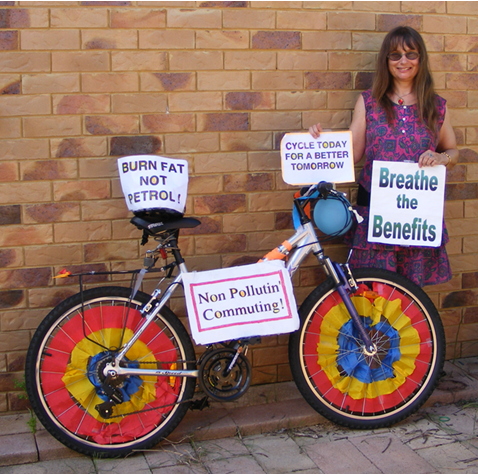
It became obvious that cycling was the best and most convenient way to travel in cities when I bought a second hand bike at the age of 17 in my 2nd year at Aberdeen University.
Other people thought so too. When I moved to Edinburgh, cyclists were starting to lobby for a cycle route across the Meadows from the south to the central area. The Lothian Cycle Campaign – Spokes – was born and continues to this day. Notable successes included the Meadows cycleway, disused railway lines converted into a network of traffic-free cycle routes across the city, maps of the most suitable routes, contra-flow bike lanes, cycle rallies, rides including the annual Edinburgh to St Andrews ride and increasing numbers of cyclists counted passing through key intersections. I was treasurer of Spokes for over 10 years until I moved to a small town in NSW, named after Armadale on the Isle of Skye.
Australia’s Armidale seemed like a paradise for cyclists, because of its wide streets and low traffic volumes, compared to busy cities such as Aberdeen and Edinburgh. There was even a cycleway along the Creeklands from East Armidale to the University of New England.
But my perception of cycling in Armidale changed radically after the helmet law was introduced in January 1990. At the time I rode a touring bike with dropped handlebars and soon discovered that the first helmet I bought for $50 was too heavy on the head when riding that way, so I had to get another one – the lightest one I could find.
The most significant problem was that the attitude of motorists seemed to change overnight. Until then, I’d not had a single encounter in which a motor vehicle driver had passed too close, or failed to give me my right of way.
But in the following months I had almost a dozen such encounters, starting with a lady who pulled out of a side street and forcing me to
swerve to avoid a collision. There were vehicles that overtook and immediately turned left, forcing me to turn left as well to avoid a collision, vehicles that made right turns forcing me to swerve of stop, close passing, etc., etc. Cycling in Armidale started to feel so dangerous that I seriously contemplated giving up cycling.
Rather than giving up cycling, a group of local cyclists created Cycle Safe, the Armidale Cyclists and Cycleway users Association. We wrote to the Council with several suggestions about how to improve cycling in Armidale and conducted a survey of cyclists to stimulate discussion on how to make cycling in Armidale better and more popular. A leaflet reporting the results and recommendations was distributed to cyclists and also left on parked bikes
We requested information on reported injuries in Armidale from the RTA (Roads and Traffic Authority) and plotted cyclist injuries on a map. Roundabouts stood out as a significant source of danger to cyclists, with multiple injury crashes at Markham/Rusden, Markham/Dumaresq and Donnelly/Niagara. Most injuries happened when circulating cyclists were hit by entering motorists who failed to give way.
This led to an investigation published in Road and Transport Research showing there were similar problems throughout NSW plus an additional analysis showing that constructing roundabouts at ‘Give-way’ intersections in Armidale increased injuries to cyclists from 1 in 12 intersection-years to 7 in 14 intersection-years.
Cycle-Safe joined with other local environment groups as part of the Armidale Environment Coalition. Useful improvements to cycling in Armidale include encouraging Council to provide cycle lanes on both side of Madgwick Drive, rather than a 2-way cycle track that would have created additional conflict with motor vehicles at driveways, intersections and crossing points. ‘Speed pillows’ were also installed at some roundabouts and appear to have improved the safety of cyclists at those intersections.
Our access to reported injury data also allowed us to check a claim in our City Planner’s report about a proposed roundabout at Barney and Dangar Sts that “Since 1987, there have been 63 accidents at this intersection with 54 casualties, including one fatality“. Our data showed a total of 10 injury accident and 14 people injured at that location because someone confused injury data for the entire road (which was then part of the New England Highway) with the data for that intersection. Construction of the roundabout was postponed for several years and that intersection now carries much less traffic because of the construction of a ‘bypass’ that creates a barrier between the Armidale CBD and the University of New England Campus.
My interest in cycling led to an analysis of the impact of the Australia’s bicycle helmet laws. The results, published in Accident Analysis and Prevention, showed that the reductions in numbers of child cyclists were 15 and 2.2 times greater than the increase in numbers of children wearing helmets. This suggests that the greatest effect of the helmet law was not to encourage cyclists to wear helmets, but to discourage cycling. A more detailed analysis was later published in the British Medical Journal and a follow-up analysis on Safety in Numbers in the Health Promotion Journal of Australia. This research has been used by cyclists in many countries to successfully oppose helmet laws, have thriving public bike schemes and much lower injury rates per km cycled than Australia.
Wood heater pollution was an even greater problem affecting Armidale. With the help of colleagues at UNE we researched the issue and eventually found time to publish the results – an estimated cost of over $4,000 per wood heater per year – in Atmospheric Environment. Years later, after persuading council to install low-cost PurpleAir pollution monitors, new estimates published in the Medical Journal of Australia reported costs exceeding $10,000 per wood heater per year.
The importance of these issues persuaded me to join the Greens and stand for election as a local councillor. In previous years, Armidale Dumaresq Council had had female representation, and even a female mayor, but when I was first elected in 2008, I was the sole female representative with 9 male colleagues.
After the first term, I had a much-needed break from council, and was elected again in 2017 to the amalgamated Armidale Regional Council (ARC). Thanks to the support of our community, my Climate Emergency Declaration motion passed in October 2019 and is cited on p2 of our 2025-29 Delivery Program, as well as previous Delivery Programs.
Some achievements at council were based on simple skills to understand and keep track of information, e.g. finding and reading a Voluntary Planning Agreement to counter a council staff recommendation (Agenda Item 10.6, 25 August 2021) that council had to fund bio offsets costing between $1.2 and $3.3 million.
Another simple example was a newspaper article reporting a second round of $20 million funding to fix pot-holes in New England, based on the size of each council’s local road network. Yet the km of local roads from the OLG database suggested that ARC should have been allocated $3.53 million, not the reported $1.48 million. The newspaper article had scaled up funds received in the initial funding allocation, where ARC had incorrectly based its application on the length of sealed road, whereas all other councils had used total lengths of sealed and unsealed roads. ARC reapplied and (AFAIK) received another $365,000 from the initial allocation and about $3.5 million in the second round.
Asking for data on water consumption allowed me to determine that 6.9% of users consume 50.9% of all water supplied by ARC and that 176 (1.6% of users) consume nearly 40%. Council’s 2026/27 revenue policy continues the bulk water discount of about 32% for intensive horticulture operations using more than 150 ML in the previous financial year. No organisation qualified for this discount in FY21/22, FY22/23, FY23/24 or FY24/25. Level 1 water restrictions were introduced in February 2026, followed by Level 2 restrictions in April. The intensive horticulture operation increased consumption in FY25/26 compared to the previous years and again qualified for the discount, which effectively encourages an increase in consumption because using it can be cheaper to consume 150 ML/year than 100ML/year.
ARC’s current Drought Management Plan, and the revision endorsed for public exhibition in August 2026, include a clause for scarcity pricing. Perhaps this will present an opportunity to reconsider bulk water pricing, especially when water restrictions are in force. The work on council continues!